
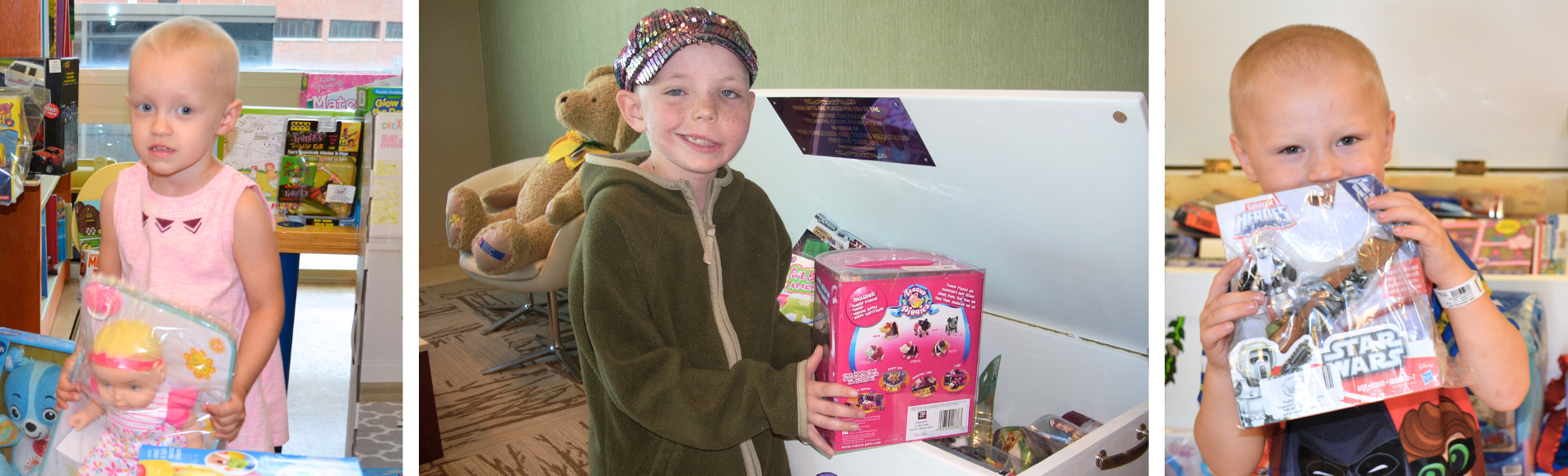
Planned Giving
Bequests
Making a charitable gift from your estate enables you to achieve financial and tax goals,
as well as benefit the mission of the Pediatric Oncology Treasure Chest Foundation.
A bequest may be right for you if:
You would like to make a gift to the Treasure Chest Foundation.
You want the flexibility to change your mind.
You want continued access to your wealth, should you need it.
You are concerned about outliving your resources.
Remembering the Treasure Chest Foundation in your will is a wonderful way for you
to make a lasting gift. A bequest gift of any size will make an important contribution
to our long-term strength and our ability to carry on with our activities.
But what if you don't have a will or living trust?
You are not alone. Most Americans don’t have a will.
If you die without a will, the laws of your state will decide how your estate is divided.
Typically, the probate court will divide your estate among your closest surviving family
members according to a formula, and none of your estate can go to the Treasure Chest
Foundation or any other charity. If you wish to have a say in how your estate is distributed,
you must have a will or living trust. We encourage you to work with an experienced
attorney to create a will or living trust that accomplishes your goals for your estate.
There are several ways that you can define the amount of your
charitable gift to the Treasure Chest Foundation such as:
A gift of a particular amount of money. For example, you give $25,000.
A gift of a specific item or items. For example, you give 1,000 shares of ABC Corporation.
A gift that will be made only if one or more conditions are met. For example, you give $25,000, provided we still offer a particular program or service, or your spouse does not survive you.
A gift that will be made from the remainder of your estate once all other bequests, debts and taxes have been paid. For example, you give 25% of the remainder of your estate. Often referred to as a "residuary bequest," this approach assures that your loved ones will be taken care of before your estate makes a bequest to us.
Designating Your Bequest
You have several options for directing the use of your bequest, once
it is received by the Treasure Chest Foundation. They are as follows:
An unrestricted bequest – This is a gift for our general purposes. This can be the most useful kind of gift because it allows us to put your gift to the best possible use at the time we receive it.
A restricted bequest – This is a gift for a specific use, such as a hospital or program that is important to you. You should consult with us before placing restrictions on your bequest to be sure we can carry out your wishes.
An honorary bequest – This is a gift made in honor of someone else. Any form of bequest can also be an honorary bequest. We would be pleased to recognize the people you wish to honor with your gift.
Ensure Your Wishes Are Honored
Your bequest must be accurately and clearly described in your estate plan so that we
can carry out your wishes as you intended. We are pleased to consult with you regarding
the terms of your bequest to make sure that we will be able to carry out your intentions.
To avoid any possible question that your bequest is to our organization, be sure to
include our full legal name and our federal tax identification number in your bequest.
Legal name: Pediatric Oncology Treasure Chest Foundation
Current Address: 15430 70th Ct., Orland Park, IL 60462
Tax identification number: 36-4111220
We have provided you with sample bequest language to assist you and your attorney at
the bottom of this section. You have complete flexibility to change your bequest at any time.
If circumstances change in a way that makes you want to revise your gift to us, you can.
Tax Benefits
Because your bequest is revocable, you do not receive an income tax charitable
deduction when you create it. Rather, your estate will receive an estate tax deduction
for the full value of your bequest in the year it is made. Depending on a variety of
factors, including the size of your estate and estate tax law at the time your estate
is settled, this deduction may or may not save estate taxes.
Bequest Alternatives
In addition to adding bequest language to your will, here
are a few simple ways you can include us in your plans:
Make the Treasure Chest Foundation a designated beneficiary of a life insurance policy.
Make the Treasure Chest Foundation a designated beneficiary of an IRA or other retirement plan.
Make the Treasure Chest Foundation a designated beneficiary of savings bonds.
Instruct your bank to "pay on death" to the Treasure Chest Foundation some or all of a specific bank account.
Instruct your brokerage firm to "transfer on death" to the Treasure Chest Foundation some or all of a specific brokerage or other financial account.
Please let us know if you have included the Treasure Chest Foundation in your
estate plans. We would welcome the opportunity to thank you for your
thoughtful gift and to confirm that we can carry out your wishes.
Example
Suzanne, a widow, has been a supporter of the Treasure Chest Foundation for
many years. Suzanne is in good health now, but does not want to be a financial
burden to her children should she require expensive health care in the future.
The Treasure Chest Foundation is one of two charities to which she has been most
dedicated. She would like to make a lasting gift to each of them in memory of her husband.
After discussing her options with her estate planning advisor, she decides to create a residuary
bequest in her will for each of her two favorite charities. Each charity will receive 50% of
the remainder of her estate after all other obligations, such as bequests to her
children and grandchildren and taxes, have been taken care of.
Benefits
Suzanne’s assets will remain available to her should she need them.
The revocable nature of her gift will minimize the possibility that she will ever need financial help from her children.
If her estate is worth what she expects when it is settled, she will be able to provide generous legacy gifts to the two charities that have meant the most to her and her late husband.
Our Recommended Bequest Language
The following is intended to help you and your attorney in drafting a bequest that satisfies
your individual interests. As you consult your attorney on the selection of appropriate wording
to reflect your own goals and intentions regarding the Treasure Chest Foundation, be sure
the organization’s correct legal name appears in all final documents as:
Unrestricted Gift: Used Where Need Is Greatest
I give, devise and bequeath to the Pediatric Oncology Treasure Chest Foundation,
Orland Park, IL, the sum of [insert dollar amount] to be used for its general purposes.”I give, devise and bequeath to the Pediatric Oncology Treasure Chest Foundation, or
its successor, the sum of [insert dollar amount] to be used for its general purposes.
Residuary Bequest: Gifts After All Others Are Paid
I give, devise and bequeath to the Pediatric Oncology Treasure Chest Foundation, Orland Park, IL,
[insert percentage] percent of the residue of my estate, to be used for its general purposes.
I give, devise and bequeath to the Pediatric Oncology Treasure Chest Foundation, or its successor,
[insert percentage] percent of the residue of my estate, to be used for its general purposes.”
Contingency Gift: Takes Effect Only If Primary Intention Can’t Be Met
In the event that [insert name] predeceases me, I give, devise and bequeath his/her bequest or share to the Pediatric Oncology Treasure Chest Foundation, Orland Park, IL, to be used for its general purposes.
In the event that [insert name] predeceases me, I give, devise and bequeath his/her bequest or share to the Pediatric Oncology Treasure Chest Foundation, or its successor, to be used for its general purposes.
Note: Instead of specifying a fixed dollar amount, you may leave a
percentage of your estate or describe the property you wish to give.
Most donors leave their gifts without restriction, allowing the Foundation to use
them to fulfill its mission locally and nationally. We honor a donor’s stated intent for the
use of a gift. Those who wish to designate how a gift is used—whether during their lifetime
or through their estate—will have that wish respected. Bequest provisions designated for
a specific program or activity require additional language, so it’s best to contact
us in advance to ensure your wishes are properly understood.
Bequests
Remembering the Treasure Chest
Foundation in your will is a wonderful
way for you to make a lasting gift. A
bequest gift of any size will make an
important contribution to our long-term strength and our ability to carry
on with our activities.
But what if you don't have a will or
living trust? You are not alone. Most
Americans don’t have a will.
If you die without a will, the laws of your
state will decide how your estate is divided. Typically, the probate court will divide your estate among your closest surviving family members according to a formula, and none
of your estate can go to the Treasure Chest Foundation or any other charity. If you
wish to have a say in how your estate is distributed, you must have a will or living
trust. We encourage you to work with an
experienced attorney to create a will
or living trust that accomplishes
your goals for your estate.
There are several ways that you can define
the amount of your charitable gift to the
Treasure Chest Foundation such as:
You would like to make a gift to the Treasure Chest Foundation.
You want the flexibility to change your mind.
You want continued access to your
wealth, should you need it.You are concerned about outliving
your resources.
Making a charitable gift from your
estate enables you to achieve financial
and tax goals, as well as benefit the
mission of the Pediatric Oncology
Treasure Chest Foundation. A
bequest may be right for you if:
A gift of a particular amount of money. For example, you give $25,000.
A gift of a specific item or items.
For example, you give 1,000 shares
of ABC Corporation.A gift that will be made only if one
or more conditions are met.
For example, you give $25,000,
provided we still offer a particular program or service, or your spouse
does not survive you.A gift that will be made from the remainder of your estate once all
other bequests, debts and taxes
have been paid. For example, you
give 25% of the remainder of your estate. Often referred to as a
"residuary bequest," this approach
assures that your loved ones will be
taken care of before your estate
makes a bequest to us.
Designating Your Bequest
An unrestricted bequest – This is a gift
for our general purposes. This can be
the most useful kind of gift because it allows us to put your gift to the best
possible use at the time we receive it.
A restricted bequest – This is a gift
for a specific use, such as a hospital or program that is important to you.
You should consult with us before
placing restrictions on your bequest
to be sure we can carry out your
wishes.An honorary bequest – This is a
gift made in honor of someone else.
Any form of bequest can also be
an honorary bequest. We would
be pleased to recognize the people
you wish to honor with your gift.
You have several options for directing
the use of your bequest, once it is
received by the Treasure Chest
Foundation. They are as follows:
Ensure Your Wishes Are Honored
Your bequest must be accurately and clearly described in your estate plan so that we can carry out your wishes as you intended. We
are pleased to consult with you regarding
the terms of your bequest to make sure that
we will be able to carry out your intentions.
To avoid any possible question that your
bequest is to our organization, be sure
to include our full legal name and our
federal tax identification number
in your bequest.
Legal name
Pediatric Oncology
Treasure Chest Foundation
Current Address
15430 70th Ct., Orland Park, IL 60462
Tax identification number
36-4111220
We have provided you with sample
bequest language to assist you and your
attorney at the bottom of this section. You
have complete flexibility to change your
bequest at any time. If circumstances
change in a way that makes you want
to revise your gift to us, you can.
Tax Benefits
Because your bequest is revocable,
you do not receive an income tax charitable
deduction when you create it. Rather, your
estate will receive an estate tax deduction
for the full value of your bequest in the year
it is made. Depending on a variety of
factors, including the size of your estate
and estate tax law at the time your
estate is settled, this deduction may
or may not save estate taxes.
Bequest Alternatives
Make the Treasure Chest Foundation
a designated beneficiary of a life insurance policy.Make the Treasure Chest Foundation
a designated beneficiary of an IRA or other retirement plan.Make the Treasure Chest Foundation
a designated beneficiary of savings
bonds.Instruct your bank to "pay on death"
to the Treasure Chest Foundation some
or all of a specific bank account.Instruct your brokerage firm to
"transfer on death" to the Treasure
Chest Foundation some or all of a
specific brokerage or other financial
account.
In addition to adding bequest language
to your will, here are a few simple ways
you can include us in your plans:
Please let us know if you have included
the Treasure Chest Foundation in your
estate plans. We would welcome the
opportunity to thank you for your
thoughtful gift and to confirm that
we can carry out your wishes.
Example
Suzanne, a widow, has been a supporter of
the Treasure Chest Foundation for many
years. Suzanne is in good health now, but
does not want to be a financial burden
to her children should she require
expensive health care in the future.
The Treasure Chest Foundation is one of
two charities to which she has been most
dedicated. She would like to make a lasting
gift to each of them in memory of her
husband. After discussing her options with
her estate planning advisor, she decides
to create a residuary bequest in her will
for each of her two favorite charities. Each charity will receive 50% of the remainder
of her estate after all other obligations,
such as bequests to her children and grandchildren and taxes, have
been taken care of.
Benefits
Suzanne’s assets will remain available
to her should she need them.The revocable nature of her gift will minimize the possibility that she will
ever need financial help from her
children.If her estate is worth what she expects when it is settled, she will be able to
provide generous legacy gifts to the
two charities that have meant the
most to her and her late husband.
Our Recommended
Bequest Language
The following is intended to help you
and your attorney in drafting a bequest
that satisfies your individual interests. As
you consult your attorney on the selection
of appropriate wording to reflect your
own goals and intentions regarding the
Treasure Chest Foundation, be sure the organization’s correct legal name
appears in all final documents as:
Unrestricted Gift:
Used Where Need Is Greatest
I give, devise and bequeath to the Pediatric Oncology Treasure Chest Foundation, Orland Park, IL, the sum
of [insert dollar amount] to be used
for its general purposes.I give, devise and bequeath to the Pediatric Oncology Treasure Chest Foundation, or its successor, the sum
of [insert dollar amount] to be used
for its general purposes.
Residuary Bequest:
Gifts After All Others Are Paid
I give, devise and bequeath to the Pediatric Oncology Treasure Chest Foundation, Orland Park, IL, [insert percentage] percent of the residue
of my estate, to be used for its
general purposes.
I give, devise and bequeath to the Pediatric Oncology Treasure Chest Foundation, or its successor, [insert percentage] percent of the residue
of my estate, to be used for its
general purposes.”
Contingency Gift: Takes Effect Only
If Primary Intention Can’t Be Met
In the event that [insert name] predeceases me, I give, devise and
bequeath his/her bequest or share
to the Pediatric Oncology Treasure
Chest Foundation, Orland Park, IL,
to be used for its general purposes.In the event that [insert name] predeceases me, I give, devise and
bequeath his/her bequest or share
to the Pediatric Oncology Treasure
Chest Foundation, or its successor,
to be used for its general purposes.
Note: Instead of specifying a fixed
dollar amount, you may leave a
percentage of your estate or describe
the property you wish to give.
Most donors leave their gifts to the
Treasure Chest Foundation without
restriction, allowing the Treasure Chest Foundation to use these funds to fulfill
its mission—both locally and nationally.
The Treasure Chest Foundation honors a donor’s stated intent for the use of a gift. Donors who wish to designate how any gift
is used, whether made during their lifetime
or through their estate, will have that wish respected. Bequest provisions designated
for a specific program or activity require additional language. It is best to contact the Treasure Chest Foundation in advance
for assistance to ensure your wishes
are properly understood.
Beneficiary Designation
A beneficiary designation is one of the simplest ways to make a gift to
the Treasure Chest Foundation—it’s literally as easy as filling out a form.
You can specify the individuals and charities you wish to support,
as well as the percentage of assets each beneficiary will receive.
Beneficiary designations can be made for the following types of assets:
Retirement Assets
An alternative to a bequest is to designate the Treasure Chest Foundation as the beneficiary
of your retirement assets. This gift is simple, allowing you to control the transfer of these
assets at your death without changing your will or living trust. All you need to do is request
and complete a new beneficiary designation form from your plan administrator.
Gifting retirement assets is also one of the most tax-efficient ways to give through your estate.
If left to individuals, retirement assets are subject to income tax, and for most non-spouse
beneficiaries, distributions must occur within 10 years—potentially pushing them into higher tax
brackets. By designating your retirement assets to a non-profit such as the Treasure Chest
Foundation, 100% of the funds are available for its charitable purposes. Often, it makes sense
to leave other types of assets—cash, securities, or real estate—to your heirs, while giving
the more heavily taxed retirement assets to the Treasure Chest Foundation.
Life Insurance
Life insurance policies can also be used to make a gift. Simply complete and return a
form to your insurance company designating the Pediatric Oncology Treasure Chest
Foundation as the beneficiary of all or a portion of your policy’s death benefit.
Alternatively, you may transfer ownership of the policy to the Foundation.
Doing so can provide an immediate income tax charitable deduction and
potential income tax savings in the year of the gift.
Commercial Annuity Contracts
Some commercial annuities may retain a remaining value at the end of the annuitant’s
lifetime. You can direct all or a portion of this amount to the Treasure Chest Foundation
by naming the Foundation as a beneficiary, either fully or partially, using the
appropriate form provided by your insurance company.
Bank Accounts
You can instruct your bank to pay the Treasure Chest Foundation all or a portion of
the remaining balance in a checking or savings account. Your bank can provide
the appropriate beneficiary designation form.
Investment Accounts
You can direct your investment company to transfer some or all of the investments
in your account to the Treasure Chest Foundation at the time of your passing. Your
broker or agent can guide you through the process—often it’s as simple as adding
“T.O.D. to the Pediatric Oncology Treasure Chest Foundation”
after your name on the account.
Beneficiary Designation
A beneficiary designation is one of the
simplest ways to make a gift to the
Treasure Chest Foundation—it’s literally
as easy as filling out a form.
You can specify the individuals
and charities you wish to support,
as well as the percentage of assets
each beneficiary will receive.
Beneficiary designations can be made
for the following types of assets:
Retirement Assets
An alternative to a bequest is to designate
the Treasure Chest Foundation as the beneficiary of your retirement assets. This
gift is simple, allowing you to control the transfer of these asset at your death without changing your will or living trust. All you
need to do is request and complete a
new beneficiary designation form
from your plan administrator.
Gifting retirement assets is also one of
the most tax-efficient ways to give through
your estate. If left to individuals, retirement assets are subject to income tax, and for
most non-spouse beneficiaries, distributions
must occur within 10 years—potentially
pushing them into higher tax brackets.
By designating your retirement assets to
a non-profit such as the Treasure Chest Foundation, 100% of the funds are
available for its charitable purposes.
Often, it makes sense to leave other
types of assets—cash, securities or real
estate—to your heirs, while giving the
more heavily taxed retirement assets
to the Treasure Chest Foundation.
Life Insurance
Life insurance policies can also be used
to make a gift to the Treasure Chest
Foundation. Simply complete and return
a form to your insurance company
designating the Pediatric Oncology
Treasure Chest Foundation as the
beneficiary of all or a portion of
your policy’s death benefit.
Alternatively, you may transfer ownership
of the policy to the Foundation. Doing
so can provide an immediate income
tax charitable deduction and potential
income tax savings in the year of the gift.
Commercial Annuity Contracts
Some commercial annuities may
retain a remaining value at the end of
the annuitant’s lifetime. You can direct
all or a portion of this amount to the
Treasure Chest Foundation by naming
the Foundation as a beneficiary, either
fully or partially, using the appropriate form provided by your insurance company.
Bank Accounts
You can instruct your bank to pay the
Treasure Chest Foundation all or a
portion of the remaining balance in
a checking or savings account. Your
bank can provide the appropriate
beneficiary designation form.
Investment Accounts
You can direct your investment company
to transfer some or all of the investments
in your account to the Treasure Chest
Foundation at the time of your passing.
Your broker or agent can guide you
through the process—often it’s as simple
as adding “T.O.D. to the Pediatric
Oncology Treasure Chest Foundation”
after your name on the account.